

About the Book
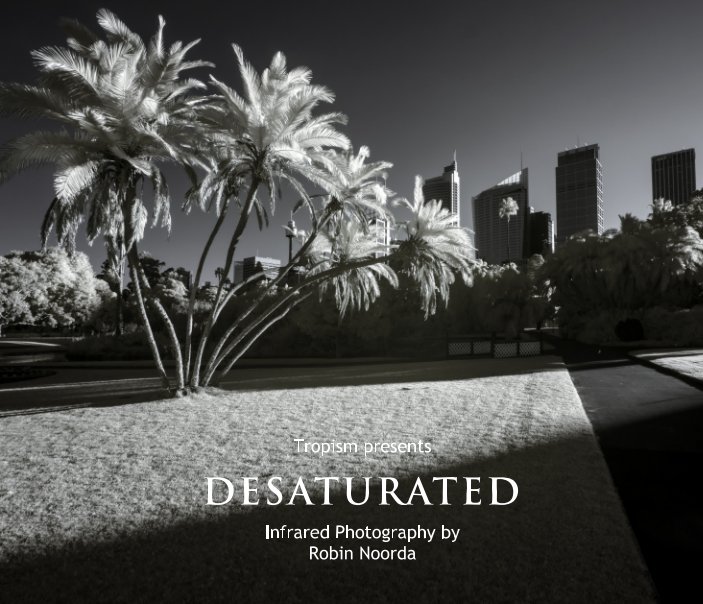
In the so-called ‘near infrared spectrum’ leaves, plants and grass colour blue to white, as if there were frost on the branches and leaves. The detail in the shadows remains much more visible. The blue sky gets a deep burgundy red colour. All this creates an extraordinary range of contrast in a world of magic realism.
Insects are not able to see red, and, just like birds, are able to see more clearly in the ultraviolet part of the spectrum. Plants use this ultraviolet part to achieve even brighter colours with which to attract insects for pollination and to alert birds to ripe fruit, berries and seeds. What we see in infra-red is actually the plant in a pure way, without the colours that are designed to lure animals. The unadorned plant, stripped of make-up, the shamelessly naked plant, as it were.
But perhaps it is also the perception of an alien creature that views our blue-green planet as, respectively, a red and light blue fairytale landscape. Or conversely, it may resemble a once lush landscape on Mars, with dark red skies and alien, icy blue vegetation.
Normally infrared pictures are presented in black and white as people are not familiar with those strange colours. We are used to black and white infrared pictures as the early infrared films where black and white anyhow.
I like the strange colour spectrum of digital infrared photo's though, and present my pictures in the vivid book 'Vibrance' and this book called 'Desaturated', in which a slight touch of this world colours remain in almost black and white.
Robin Noorda, Amsterdam 2019
Insects are not able to see red, and, just like birds, are able to see more clearly in the ultraviolet part of the spectrum. Plants use this ultraviolet part to achieve even brighter colours with which to attract insects for pollination and to alert birds to ripe fruit, berries and seeds. What we see in infra-red is actually the plant in a pure way, without the colours that are designed to lure animals. The unadorned plant, stripped of make-up, the shamelessly naked plant, as it were.
But perhaps it is also the perception of an alien creature that views our blue-green planet as, respectively, a red and light blue fairytale landscape. Or conversely, it may resemble a once lush landscape on Mars, with dark red skies and alien, icy blue vegetation.
Normally infrared pictures are presented in black and white as people are not familiar with those strange colours. We are used to black and white infrared pictures as the early infrared films where black and white anyhow.
I like the strange colour spectrum of digital infrared photo's though, and present my pictures in the vivid book 'Vibrance' and this book called 'Desaturated', in which a slight touch of this world colours remain in almost black and white.
Robin Noorda, Amsterdam 2019
Features & Details
- Primary Category: Arts & Photography Books
-
Project Option: Standard Landscape, 10×8 in, 25×20 cm
# of Pages: 58 -
Isbn
- Hardcover, ImageWrap: 9780368296901
- Publish Date: Feb 13, 2019
- Language English
See More
About the Creator

Tropism Art & Science Collective
Amsterdam, NH, Netherlands